 Quite a few of my students come from non-traditional project management fields – scientists, professors, fashion designers, Solopreneurs and so on. This goes to prove the value of PMP® as a project management knowledge base. I’ve noticed that each one has their own unique PMP® preparation approach though.
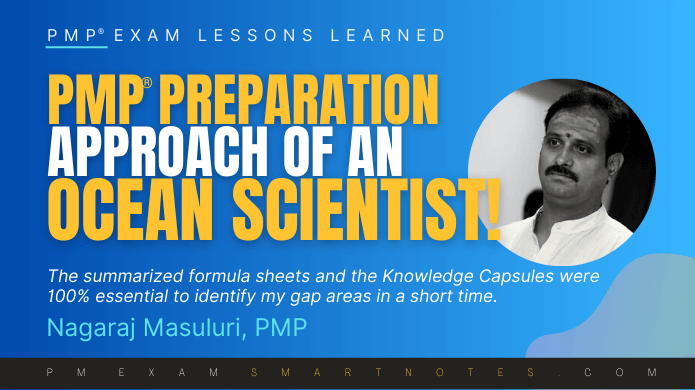
In this week’s PMP Lessons Learned article, an Ocean Scientist, Nagaraj Masuluri, shares his PMP® exam experience and approach.
Nagaraj completed his post graduation in Physics. Presently pursuing Ph. D. in Remote Sensing and Satellite Telemetry based studies in Fisheries.
Nagaraj is working as a Scientist in an autonomous body of Govt of India where they do research about Oceans and then convert the research findings into an operational services useful for the public.
This is a long one, so get your paper and pencil to make some notes.
Being a scientist, why did you go for PMP®?! 🙂
 I have been working in a government R & D sector, studying about Oceans. We have our own set of guidelines, rules and procedures to follow when we deal with various projects planning, execution, etc.
For long I have been wondering about mainstream project management practices, and interested to know how they are different what we follow. This line of inquiry also could help me be better at my work, I have hoped.
Initially I heard about PMP® and much later about PRINCE. I preferred PMP® because I felt that it covered all aspects of projects of all sizes pretty well.
Now that you are PMP® certified, what benefits would you expect?
My field of working is completely different and there is no weightage that I may be accruing due to PMP certification.
It was my own interest and passion about knowing the best practices in project management and I wanted to see if I could use it while planning, executing and implementing the projects in my career.
And another motivation that I could see by doing PMP was the value of PMP certification that can fetch me a new role, if I plan to move to private sector.
Reading the PMP material, twice, made me to grasp a larger portion of knowledge that PM should possess and this is going to help me in adopting good practices while dealing with projects at my office, especially while planning the projects and monitoring and controlling the associated risks.
Which study resources did you consider, and eventually used for the exam preparation?
I was also a successful applicant of PMIEF and secured PM Prep cast training and simulator free of cost for PMBOK 5th edition.
But due to various reasons I was never able to complete it. Although work kept me busy, I had been following various sites / blogs such as Shiv’s Blog PMExamSmartnotes.com, articles from projectmanager.com, and university courses on project management, etc.
Eventually I purchased the book-set of Shiv Shenoy’s Ace Your PMP® Exam.
Also, I subscribed to PMI Membership with my local chapter.
Then tried with Shiv’s PMP® Launchpad, the free course, and got more inclination and then subscribed to ‘PM Exam Last Mile Prep Program’.
I followed the 11 week study strategy included in this Last Mile program. [continue reading…]
 “Is the new PMP® exam harder?”, this is the often asked question ever since PMI moved to the
 I have been a business analyst for quite a long time and started the process to take the IIBA certification, but I noticed that there was not very much importance given for it by employers.

 Since my developer days I have known that PMP

 Ever since I started working in the Project management field I wanted to get formal project management education. On researching the certification possibilities the PMI PMP® stood out for me as the gold standard sorts.
 This week one of my
 I only had PMP® in mind since one of my seniors had told me about it a few years back. My primary goal is to understand all aspects of Project Management and learn the approaches, tools and techniques to manage projects the right way.