Identifty Risks processTodd planned for a weekend camping trip with his friends. They planned the route, camping gear, compass, sleeping bags, food, beer, but overlooked one important risk associated with such trips.

Todd and his friends partied into the night, enjoyed the camp-fire, and went to sleep well after mid-night. And a grizzly bear decided to say hello in the wee hours of morning.

When an unplanned risk materializes, it can cripple the project or bring it to a grounding halt.

Identifying risks is one of the easiest processes, in a way. Our minds are wired to look for things that can go wrong, and that is what required for this process. Only caution to be exercised is to keep things in the realm of practicality.

This is also where maximum effort needs to be invested. The project manager needs to involve as many stakeholders as possible in the risk identification meetings.

Who identifies risks?

It could be the same team that worked on risk planning. Or it can be the team and few more people that know about the project and/or have experience working with similar project. Some organizations have risk management experts to help project teams identify risks.

Involving the team increases a sense of ownership in them. Also, when team actively thinks about risks they develop a mental frame that helps them deal with the risks in case they materialize. [continue reading…]

Plan Risk ManagementWhat is Risk Management Planning?

Risk Management is about identifying methods of identifying and managing risks, analyzing risks, assigning responsibilities for people to handle risks, outlining risk budget, defining risk categories, creating probability and impact matrix, and identifying risk responses.

As a planning activity this process is carried as early in the project as possible, and then revisited regularly.

Why?

Simply because if you look at the risk management processes, 5 out of 7 processes are in the planning phase. Which means a lot of thought has to go into planning for risk management at the planning state itself.

And in order to do this, the project manager should start looking at all aspects of the project – right from project charter to stakeholder list to business case. In fact the risk management is to be thought about right when the project is conceived.

If you were to plant a sapling, you’ll think of all possible ways it can be troubled – from kids stomping accidentally to farm animals eating it. Similarly as soon as the project is conceived the project manager should start thinking about ways harm can come in its way.

OK, I’m convinced. What’s the right way to do this?

Great! The process itself is quite simple. This is about outlining mechanisms of identifying and managing risks and risk responses on the project.

What do we need?

Project charter – all high-level information you need such as requirements, milestones, assumptions, and constraints are available in this document. Each of these could be a source of risk, and needs to be studied carefully.

Project plan, of course – risks need to be analyzed in all activities of the project, which means that you need to study baselines and subsidiary management plans such as for cost, schedule, scope and quality. For the initial rounds though you go with whatever is available.

Stakeholder register – this document contains information such as role, interests and level of influence of stakeholders.

Every organization defines risk thresholds. That is, how much of a risk – in terms of cost incurred – can you assimilate before you start implementing risk responses.

It is important for the project manager to understand this before embarking on risk planning exercise.

Also, there are few things that give the PM a head start – risk management plans from previous projects and available templates. Some of the readily available artifacts may be predefined risk categories, formats for reports and statements, risk register, and risk terms. All these from organizational process assets.

And don’t forget lessons learned from the repository. That has a wealth of knowledge that can save the project manager from many a traps.

How easily can this be done?

Involve experts – this one technique employed at planning stage can help save a lot of time, energy and resources at later point in the project. Not to mention heartaches.

Stakeholders, team members who have worked in similar projects earlier, subject matter experts (SME), consultants, industry experts, consultants, and even senior management people in the organization can contribute in risk management planning.

Lot of risk can emanate from stakeholders (remember the definition of stakeholder is someone that is positively and negatively impacted by the project, or even those that think that they are impacted!) Hence Stakeholder analysis is also a key factor in risk planning.

You meet up with a lot of these people, and each meeting is a golden chance to bring about as many ideas as possible. Managing meeting effectively would be helpful for all involved.

What is a risk management plan?

Risk management plan describes how risk management is going to be structured and performed on the project.

Risk management plan is a subset of project management plan. It is a subsidiary plan just like other plans considered as inputs to this process. Which also means that any change to risk management plan is to be driven via change control process.

This plan gives you the methods to identify, assess and manage risks, and contains following components –

  • Roles and responsibilities of team members for conducting each activity defined in the plan
  • Risk management budget and funding, when and how should it be used on the project on realization of risks
  • Probability and impact matrix gives you a feel of the impact on project objectives when a risk materializes. Based on the probability and the impact on project objectives scale of a risk is decided. Scale is defined relatively (low, medium, high) or numerically (a value from 0 to 1).
  • Stakeholder’s tolerance decides how much of a risk can be absorbed without impacting project objectives. For instance, how long can you afford to wait before it impacts schedule when one of the critical developers falls sick – defines risk tolerance on schedule.
  • Risk categorization framework such as risk breakdown structure (RBS), like the one below that Kathy used on her landscaping project

Risk Breakdown Structure (RBS)Figure: Risk Breakdown Structure

  • How should outcome of risk management process are documented and communicated is driven by which reporting format is to be used.
  • Risk tolerance & risk appetite of stakeholders
  • Format for risk management outcome reports to be used for communicating to stakeholders
  • Definition of risk probability and impact, and the actual matrix for qualitative risk analysis. A sample risk probability and impact matrix is given below –

Sample probability and impact matrix

Figure: Sample probability and impact matrix

Risk Management plan is an important subsidiary plan of Project plan, and can be prepared much easily be banking on existing templates or sample plans in the organizational process assets. This exercise itself gives insights into some of inherent risks in the project, and sort of feeds on into next process – Identifying Project Risks!

risk management knowledge area“Good Risk Management fosters vigilance in times of calm and instills discipline in times of crisis”

– Dr. Michael Ong

What is risk?

A possibility of change in the expected outcome of a task or event implies a risk.

Every activity has an inherent risk in it. Even walking on the road has its own risks, like getting hit by a truck.

Simplest of the tasks on a project has risks. For instance, as release deadline gets closer project’s software architect may fall sick, thereby increasing the risk of delivery. Any of scope, cost, schedule and quality of the project may affected due to materialization of a risk.

On the day you wanted to buy that project management software, you come across a discount code that saves you 50% on the price! This is also a risk – although a positive one. Positive risk is called an opportunity.

If risk occurs on a project it may lead to a positive or negative impact on one or more of project objectives.

The goal of the project manager in Risk Management is to enhance the probability of occurrence and increase the positive impact of Opportunities, and decrease the probability of occurrence and eliminate or decrease the negative impact of Threats. This leads to achievement of project objectives.

There are “known unknowns” and “unknown unknowns” on a project. What does this mean?

“Known unknowns” are identified risks on the project.

If you have only one architect working on the project you know that if he has an emergency there is no one to fill in for him during his absence. Such risks cost you money when they materialize. This cost is covered from Contingency Reserves.

“Unknown unknowns” are those risks that you cannot proactively identify.

During project execution, your lead developer may find out that a piece of scope was never captured in the Requirements documentation. You cannot plan for these types of risks. When unknown unknowns occur, their cost is covered from Management Reserves.

Risk Tolerance

Every organization has some amount or risk tolerance. Degree or tolerance depends on factors such as nature and complexity of project, extent of rewards in the offering.

If you are building a nuclear reactor the amount of risk tolerance would be much lower, whereas you may exhibit more risk tolerance for a software product that is looking to time the market.

[continue reading…]

Plan communications and communicate the plan.

Plan Communications

“Science may never come up with a better office communication system than the coffee break.”

– Earl Wilson

A project generates loads of information. Not all of it will be relevant to everyone. Not getting right information or getting irrelevant information – both are not ideal.

Communication planning is all about deciding who should get which information, when, and who should send it, in what format and by which channel.

It takes into account the existing communication methods, channels, policies, and best practices and of course the lessons learned from earlier projects in the organization.

Information sensitivity is an important area for project manager to consider while making the communication plan.

Critical information such as financials and contractual data is not for consumption by everyone, and can create issues or pose risks for project success if reaches wrong stakeholders.

Communication plan is something that is created, at least to some extent, at the early stages of the project. Potentially as soon as stakeholders are identified in the Initiating stage. Once stakeholders are identified, they need to be communicated to make any progress on the project. So as one can see the communication plan is something that is iterated and developed incrementally.

Also, this plan is prone to regular changes because of the changes in stakeholder engagement practices, their needs, and of course the feedback project manager receives from stakeholders about communication, or change requests raised due to conflicts in the project.

[continue reading…]

Identify stakeholdersAs a project manager if you are able to identify stakeholders properly and come up with strategy to manage their expectations, much of your success is guaranteed!

We saw in an earlier post about identifying a stakeholder that “stakeholder is a person or organization, whose interests may be positively or negatively affected by execution or completion of the project.”

Identifying stakeholders is a very important activity. If one or two crucial stakeholders are missed, rest of the Communication Management processes will not yield good results no matter how well they are executed.

Consider this. What if one of the missed stakeholders comes along during project execution phase and requests for a major change? The change cannot be ignored since the person is an important stakeholder. Moreover, her interests and influence on the project were not considered during planning process. This can be a recipe for disaster. You can imagine how major issues can arise on the project if an important stakeholder does not get a required information on time.

It is important to understand that stakeholders’ interest can influence the project positively or negatively. [continue reading…]

Basic Communication Model

basic communication modelOxford dictionary defines communication as “imparting or exchanging of information by speaking, writing or some other medium.”

While it sounds simple, effective communication in project management is pretty big a challenge. Being able to communicate your thoughts in a way that the other person understands in the same way as you intended – is a hard thing.

Why?

Because when two people talk many aspects of communication come into play – choice of words, framing of sentences, tone, pitch, pauses, eye contact, body language, hand gestures – variation of each of these can give an entirely different meaning to what was said.

No wonder then that many project managers consider communication as a major reason for IT project failures!.

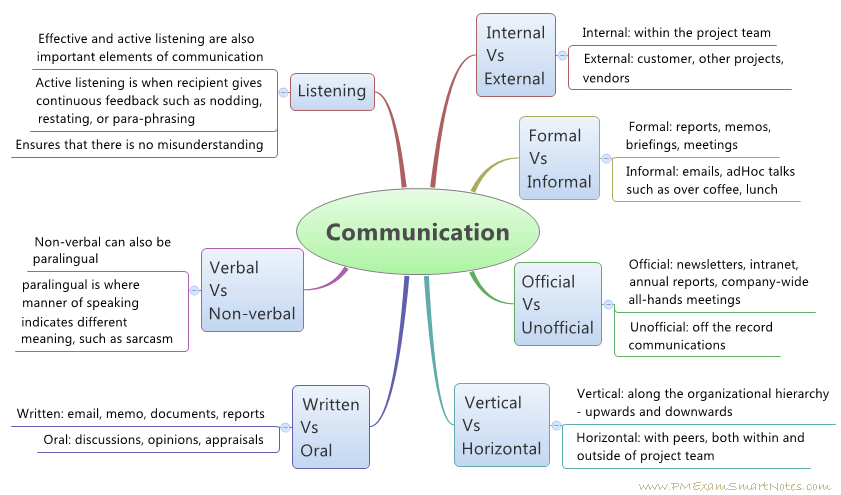
Let us look at the types of communication in a project setup

Types of Communication

Types of communication

[continue reading…]