PMP mindset is important for above target score, says Balachandiran SankaranBalachandhiran Sankaran considers himself to be an ‘eternal novice’ and avid learner of the ‘Art of the possible’.

I personally think he can write a book with that title!.

Also, that tells me his outlook toward learning. I don’t find it surprising that he’s constantly learning new things. That includes writing poems and blog posts to share his wisdom.

He has been on multiple certification sprees, and in between managed to ace his PMP exam too.

I interviewed Bala, as I used to call him on our weekly coaching calls, to get you his blueprint for PMP success.

One of his responses that stuck with me is how he got a PM lesson from a personal hardship during the PMP preparation.

Needless to say, he got all the 3 Above Target score.

Let’s hear from him.

Grab my free PMP course to supercharge your PMP study!

What made you take up PMP certification?

PMP BalachandiranI am an Agility explorer.

I wanted to explore more about the Project Manager’s world to understand and serve them better.

What was the core benefit you expected from PMP certification?

My expectation was to understand the plan-driven approach to deepen my knowledge helpful for successful Agile Transformation.

Now, I am certified and it will definitely bring a systemic approach to building a learning organization.

According to you, what is the one thing a PMP aspirant should have, to prepare well and pass the exam?

PMI mindset.

PMP is nothing but “Practicing (PMI)Mindset Perfectly!”

Practice as many questions (using the right sources) from simulators based on ECO (Exam Content Outline) to cultivate that mindset.

Which study resources did you use for your exam preparation?

I chose 4 of the best.

Want Shiv to support your PMP preparation on a daily basis for FREE?

Join these 2 study groups I run for you. You get different content on both groups every day!

What was your approach and study plan?

One thing I was clear about is getting help from mentors. And I signed up with Shiv Shenoy (as part of the Last Mile program) and EduHubSpot.

One simple strategy I used is to study daily. [continue reading…]

PMP after PhD, Felcy GabrielFelcy Gabriel is an Application Design & Support Process Manager at the State University System of Florida – Board of Governors. She has a Ph.D. in Crystallography and Biophysics.

Yes, it’s not the usual background we’d expect for project management!

But then that’s the beauty of this certification. If your work involves handling any type of project in any field/industry/vertical – you can, and must, get PMP.

The benefits are enormous!

Felcy did it in 3 months.

Let’s just get to know how she did it.

Grab my free PMP course to supercharge your PMP study!

What made you take up PMP?

I was promoted to Application Design and Process Manager back in June 2019 and my new position motivated me to take up the PMP certification.

What was the core benefit you expected from PMP certification?

PMP Felcy GabrielI wanted to learn about Project Management and apply what I have learned to my job.

I have become more confident in my new position after passing the exam.

When I went back to work, I received a lot of appreciation from my manager and peers.

Which study resources did you use?

I began with PMBOK Guide 6th Edition.

Then, I used Rita Mulcahy’s PMP book (easier read). [continue reading…]

5yr PMP planning realized in 4 weeks without PMBOK, says RyanPMP Without PMBOK: Simple Strategy I Used To Certify In Just 4 Weeks – Ryan Bird, PMP

“The first time I was going to take the exam, work was picking up in Europe for me.

I thought, ‘oh this will be great, I’ll just read on the flight.’

I took the PMBOK with me and started reading as we were taking off. Hours later I woke up in Amsterdam.

After the layover, I thought, ‘ok well, I’ll get an hour in before getting to Warsaw.’

Nope.

On my return flights, it was the same story.

I read maybe 20 pages total on 2 transatlantic flights.

I did not have a coach for the exam and thought that reading the PMBOK would be the answer. After that trip, I set the PMP aside for 5 years and never took the exam. I was using the PMBOK and company-provided resources to prepare back then.

Looking back, a coach would have made a world of difference for me.

Fast forward 5 years to actually testing, I did not read a page of the PMBOK to prepare for the exam.

Coaching saved me a considerable amount of time and energy.”

Says Ryan Bird.

👇 In a hurry? Watch this short video 👇

And if you’re thinking that he did it without PMBOK and with the help of a coach, you should also know that it took him just 4 weeks.

Ryan is from Cincinnati, Ohio. He’s spent a decade and a half handling projects. He’s a Program Manager at a Fortune 100 Telecom company in the US, handling projects worth $60M a year.

When not working, Ryan is busy mentoring younger employees and coaching his kids’ sports teams.

What made you take up PMP?

PMP Above Target, Ryan BirdI was working for General Electric and PMP certification was being promoted within our PMO.
I had already been certified as a Lean Six Sigma Black Belt several years prior.

Therefore, PMP certification seemed like the natural next step for me.

What’s the core benefit you expected from PMP certification?

My original expectation of the PMP certification was that I would have a slight edge for promotion over similar candidates that did not.

I think having the PMP certification serves as a credential booster.

What’s the single most important quality a PMP student should have?

The right Mindset.

I think a lot of people go into the exam with an incorrect mindset; the project management world promotes that the exam is the most difficult undertaking in the world. It’s not.

Consider this.

Those that are taking the test have been managing projects for years, with that being the case I guarantee you have had a project go sideways. An out-of-control project is much worse than taking the PMP exam.

You need to get your head straight if you are doubting yourself.

Write out your prior victories.

Focus on your prior successes; this is going to be another to add to the list.

Start speaking that you are passing the exam. If your mind is focused on the positive it works a lot better.

Before I would start studying every day, I would tell myself this: ‘I am going to pass this exam on the first try and I am putting in the work to make that happen now’.

Before going in to take the exam I spoke about my expectations as well. [continue reading…]

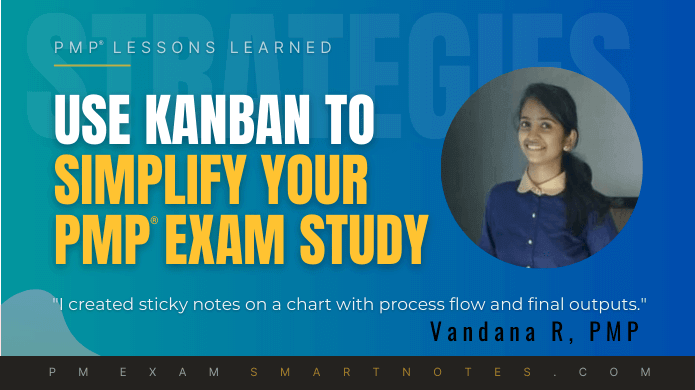
Kanban board approach for PMP study is the best - Vandana R“I cannot tell you how easy my PMP studies became because of the Kanban approach.”, said Vandana when I asked her to share some study insights for those preparing for PMP.

Vandana is a postgraduate in Construction Management with 4 years of experience in project planning & execution.

Outside of her work, she enjoys practicing street photography and public speaking.

Her Kanban approach was smart, I thought.

A perfect fit for studying for PMP, if you can create a series of study tasks.

I do recommend giving this approach a go for your preparation. There’s something magically simple with the approach.

Vandana scored an overall score of Above Target in her PMP exam. I hope you will find some of her suggestions useful.

How did you come to choose PMP?

Kanban approach by VandanaI began to consider my self-learning options to enhance career prospects, and a bit of research was enough to find that PMP is the first choice.

The journey has completely changed my personality & mindset.

I have learned that it is relatively easier to manage projects but the real toughness lies in making smart decisions & performing under pressure. PMP certification turned out to be a process of self-discovery.

Through PMP study I expected to learn about the right way to manage projects.

I had exposure to tailoring processes through my work experience. The standards by PMI gave me a perspective to analyze things logically.

👇 In a hurry? Watch this short video 👇

Grab my free PMP course to supercharge your PMP study!

What’s the main ingredient needed for PMP success?

The mindset of a project manager.

I realized during the exam that no amount of mock tests and material can truly prepare you for the real exam. It does not mean that you do not take mock tests, they are a must-do in my view.

All the effort was to develop a mindset to face circumstances on a daily basis.

While studying every concept, analyze “why”& “what can be done next” before taking any action for the problem. That’s what the exam tests you about.

That’s great insight! What resources did you use?

I took the Simplilearn training for 35 project management education hours certificate, a mandatory requirement by PMI. They provided good support for my preparation.

Apart from that, I utilized the following :

[continue reading…]

sprint effectiveness 3ways to skyrocketYou understand how the Sprint is run.

During the Sprint planning, some of the Product Backlog Items (PBIs) are moved into the Sprint backlog based on the team’s capacity, to be completed in the stipulated Sprint timeframe.

In spite of doing it, there are chances that the team often falls short of completing scoped items.

Sprint after Sprint.

Even with retrospectives in place.

There are a few things that are often overlooked or ignored for a Sprint to be effective.

In this article, we shall look at 3 such items.

If you find the article useful, take a moment to share it with someone that may need it.

1. Ensure everyone on the team understands DoR and DoD

How would you hit a goal if you don’t know what it looks like?

Interestingly, many Sprint teams do not have a clearly defined understanding of the Definition of Ready and Definition of Done.

Definition of Ready defines the state that a Product Backlog Item (PBI) should be in when it is moved into the Sprint backlog.

A sample DoR checklist could be something like this –

agile sprint definition of ready

Figure 1: Example of Definition of Ready for User story

Definition of Done defines the state of the task when it is marked as ‘Complete’ by the team member.

An example of DoD checklist would look like this –

agile sprint definition of done

Figure 2: Example of a Definition of Done

These are validated by following the predefined checklist.

Unless these are defined ahead of time and understood by the team members, uncertainties & misunderstandings can easily creep into the Sprint and the outcome could be compromised.

You may also enjoy:

[continue reading…]

3-stage PMP prep approach Abubaker, PMPAbubaker Muzzamil is a Civil engineer working in Dubai. He’s certified in PMP and PMI-RMP.

He also works with the PMI UAE chapter in a part-time capacity.

In this post Abubaker shares what got him hooked to PMP dream, and how he achieved it.

An interesting thing I noted is that Abubaker actually ramped down the daily study time as the exam approached!

Also, in order to avoid the clock pressure, he took full-length tests without a time limit.

He said one of his approaches was a mistake, and he’d advise people to avoid the mistake.

Want a free PMP course to kick-off your preparation?

What made you take up PMP certification?

PMP AbubakerI got initiated on the PMP journey by a family member who has been working in the project management community for almost 20 years. He gave me a broad idea about the certificate and the value it brings to one’s career.

After a lot of research and getting background knowledge, I realized that PMP would help me advance my career. As an engineer, it is a big addition to my technical experience, because we’re always surrounded by project environments.

Which study books did you use?

I spent a good part of 5 months preparing for the exam.

When I began researching for exam resources, I came across Rita Mulcahy’s offer. I used resources developed by her company, RMC – including the PMP exam prep book and a Fast track simulator.

Apart from these, I also referred to the Head First book.

I used about 80% of Rita Mulcahy’s resources and 20% of the rest of them.

You may also enjoy:

How did you approach the preparation?

My study journey was easy to plan, but hard when it comes to executing it. 🙂

  • Stage 1: Study using PMBOK guide
  • Stage 2: Study using Rita’s book
  • Stage 3: Take practice questions

[continue reading…]

Share via