StakeholdersConsider this scenario.

State government puts up a proposal to change the path of river Netravathi so that the dry lands above Western Ghats (in India) can be irrigated. This will benefit hundreds of farmers who will get water for most part of the year for irrigation.

However, a set of farmers whose farmlands will be acquired by the government for this project, stage a protest.

Who are the stakeholders in this project?

The farmers who stand to gain when river path is changed, farmers who are losing their farmlands, the government, or the construction company that executes the project?

[continue reading…]

Enterprise Environmental Factors

Okay, let me give it out straight away.

Enterprise Environmental Factors (EEF) and Organizational Process Assets (OPA) – are two inputs that appear in quite a few processes.

Rightly so.

Because both are part of the environment in which a project is undertaken, and just like people a project also is shaped by its environment.

These are very important aids for the project manager, they make her life so much easier!

Enterprise Environmental Factors (EEF)

We all live in and depend on some kind of environment. At home, we have a ‘family environment’, and with friends we have a ‘cool environment’. Multinational companies look for a favorable political and socio-economic environment to conduct business in a country. And of course, we all depend on clean, pollution free environment to have a healthy living. [continue reading…]

How to become good project managerHow do you identify a Project Manager?

There are other types of managers too in an organization!

It is essential to be able to recognize the duties of a Project Manager as compared to other types of managers that work in an organization.

That is to speak, to know the differences between Functional Manager (FM), Operations Manager (OM) and Project Manager (PM). Knowing this will help you know if/when your duties are overlapping that of FM or OM.

Don’t miss the downloadable infographics at the end of this post.

What does a Functional Manager do?

A Functional Manager is responsible for a specific function of an organization, such as Finance, Customer Success, Sales, or Human Resources.

If a project manager is working in a matrix organization, she needs to forge and maintain a good relationship with functional managers in order to ensure project’s success. This is because in such organizations project team members would be reporting to functional managers. In some cases, project manager may even be reporting to a functional manager. We will learn more about organizational types in an upcoming lesson.
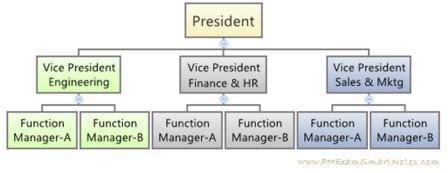
Functional organization

Figure 1: Organizational structure of a Functional Organization

What does a Operations manager do??

Operations is an ‘ongoing’ activity of an organization, and an operations manager manages them. For instance, IT team of a company manages IT Operations. A catering service serving food to patients in a hospital – is also an example of Operations.

Projects can intersect with operations at different milestone points. For instance, when a project phase closes and the enhanced product is released, Maintenance team is trained on usage and troubleshooting of the new features, so it can do support customers. Project managers and Operations managers collaborate to plan such activities.

What does a Project manager do?

In brief, a project manager is responsible for achieving project objectives.

But the devil is in the details, right? Project manager should be able to understand, plan for and manage several aspects of running a project successfully, such as project and product requirements, schedule, costs, quality of deliverables, human resources, communication needs, risks, procurement of materials and services and managing stakeholders’ needs. These aspects are termed by PMBOK® as Knowledge Areas.

Also read: My recommended PMP (and CAPM) exam study resources (download free ones)

What are the differences between these 3 types of managers?

Project manager’s extent of power over project depends on the organization type. A matrixed organization gives lesser power and authority to its project manager if it is of weak-matrix type. To the extent that even to get human resources or budget, project manager needs to have approval from functional managers. It is a well-known fact that unless you are managing your team directly there is a limit to the amount of influence you may have over the team.

The mind-map below shows responsibilities of three types of managers, and how a project manager interacts with functional manager and operations manager. Click on the image to open in new window.
3 types of managers

Figure 2: Three types of managers in an organization

Also read: 9 ways to avoid employee burnout in your team

What does it take to be a good Project Manager?

Being a good (read ‘effective’) project manager is a hard task. But the good news is that PMBOK® guides us on all that is required to become one.

Three fundamental characteristics of an effective project manager are –

  • Knowledge: What do you know about your job…
  • Performance: How do you put that to use…
  • Personal skills: How do you deal with people involved while doing it…

Now,

  • The knowledge is available (formed around the processes) in PMBOK® book.
  • You need to put that knowledge into practice at your organization and derive a good performance.
  • Effectiveness as a project manager needs personal skills to deal with team, customer, executive management and other stakeholders involved in the project. An effective project manager also needs to have great attitude, analytical skills, ethical mindset, and interpersonal skills such as –
  • Leadership
  • Team building
  • Motivation
  • Communication
  • Active listening
  • Influencing
  • Decision making
  • Negotiation

You will learn more about personal skills in Human Resources Management section of this series of PMP / CPAM exam notes.
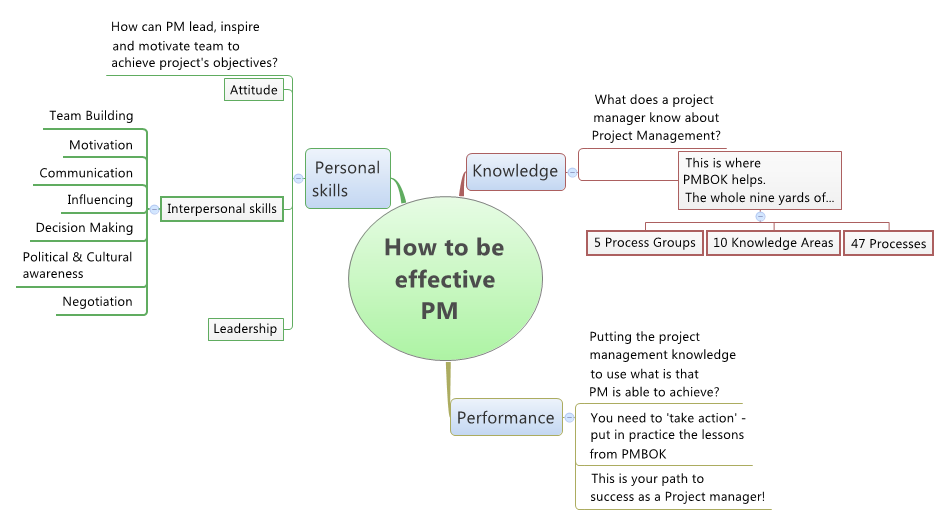
Effective project manager

Figure 3: Attributes of an effective project manager

What is project management?

Quite simply, project management is the application of knowledge, performance and personal skills of a project manager to achieve project objectives. However, this is easier said than done.

Managing a project involves dealing with constraints – mainly scope, time, cost, quality, resources and risk – we saw in the earlier lesson on project constraints. Impact on one of the constraints likely will affect other(s).

Project management involves identifying true stakeholders, documenting right requirements, coming up with optimized schedule, managing resources effectively, keeping costs in check, making project deliverables with accepted level of quality, managing good relationship with stakeholders, keeping communication channels up and running, ensuring procurement activities are running smooth, keeping top management abreast of project progress, churning out right amount of project documentation, managing positive and negative risks well, managing changes to project scope through change control process, updating various baselines, improving processes, and contributing to organizational process assets.

What does a project team consist of?

  • Project manager – responsible for managing all project activities and project team to achieve project objectives
  • Project management team – helps project manager on activities such as sending communication, identifying right templates, creating schedule and creating project documentation. Sometimes this could be just the project manager. In some cases this could be the entire project team (project manager + project staff)
  • Project staff – people who do the actual project work

Project Manager Infographics

Here are couple of infographics that explain the qualities that effective project managers around the world are exhibiting. Click on the images and download to disk.

10 characteristics of a good project manager – courtesy: taskworld.com

10 Characteristics of A Good Project Manager #infographic

So the question is how should a project manager should evolve?

One obvious answer, with the higher adoption of Agile methodology around the world is that a project manager’s role is slowly turning into that of a leader. That too what many call as ‘Servant leader’ – that is a leader that serves his team. Empowers them. Helps them achieve their highest potential.

Here’s an infographic, courtesy Jacob Morgan of thefutureorganization.com, that talks about 10 qualities of a future project manager.

10 Principles of the manager

And in this video Jacob explains the 5 trends that are impacting how you and me would be working in future. Some of these are already mainstream.. –

Summary

In this article we saw different types of managers in an organization and the characteristics of a good project manager. In this section we are looking at several concepts across many lessons. Please do not skip them, no matter how much you are tempted. Understand them thoroughly. As you move on to further sections these concepts start coming into play and it all starts to make sense.

Let us see what are the two most important inputs to processes during Planning process, at least?

6 Project ConstraintsIf you asked any seasoned project manager about the most challenging part of project management, most likely the answer would be “managing project constraints“. Or something close enough to that.

Major part of your project management effort goes into managing constraints.

Have you read about the six legged robot by NASA to make human outposts on Mars?

What do you think would happen even if one of these legs do not work as designed, or get stuck in the Martian terrain?

In simpler words, the robot would not function to the extent that it is supposed to. This will impact the Mars mission.

The 6 project constraints are similar to this 6 legged robot.

Each leg represents a constraint, and an issue with any of the constraints may impact the entire project –

6 constraints of Project - scope, schedule, cost, quality, resources, risksFigure 1: The 6 project constraints

These constraints are interrelated, so a strain on one of the constraints will affect one or more of the other constraints. The image below shows classic triple constraint triangle.

3 core project constraints

Figure 2: Impact on any of Scope, Time (Schedule) and Cost may have an impact on Quality of deliverable

Imagine pinching any of the edges of this triangle. What would happen to the other two points? They get stretched. And the area of the triangle gets skewed.

The same thing happens when any of these 3 core constraints – scope, time (in other words, schedule) and cost, are strained. Each will influence the other two – and may result in poor quality of the product.

All of the 6 constraints influence each other in that any one getting affected impacts one or more of the rest.

Some examples of how constraints are related –

  • If necessary resources are not available, time to deliver will increase. This may also increase project cost, because alternate resources if available, may be more expensive than planned.
  • If QA team finds that quality of deliverable is going bad, more resources may be required. This increases the cost (additional resources) and effort to fix the faulty deliverable. This will also increase the time to deliver.
  • If scope creep happens on the project, it will result in increased time, cost, resources and potentially reduced quality. And thus increased risk on delivery.

Managing 6 constraints is as much of an art as science. They will test the mettle of project manager. But do not worry, with the knowledge of PMBOK® processes and some support from your organization (PMO), managing these constraints should be a challenge that you enjoy.

In the next lesson we shall see who is a project manager, and how to become a good one!

Project, Program and PorfolioWhat does a project do for the organization?

Simply put, a project helps an organization achieve a goal.

Let us recall the definition of a Project –

A project is a temporary endeavor undertaken with a specific start and end date, with an expected outcome of a Product, Service, or Result.

What is a Program, then?

A program is a collection of related projects that are dependent on each other and serve a common outcome.

If these projects are to be executed separately, their value to the organization would be lesser than what you get by doing them together under a program. Projects in a program serve the purpose of a common outcome.

Exam pointer: Get this subtle difference. If the objective of a Program is only getting a shared benefit (like shared technology, client or resources), PMBOK® suggests that it should be done together as a Portfolio and not as a Program. There may be a question around this in the exam.

Let us look at an example of a Program.

XYZ Construction Company runs a program for building a township. This township consists of a luxury apartment project, low cost single-family house project, and a commercial-purpose office building project.

Example of Program

Figure 1: A program may have one or more projects

A Project may or may not have an associated Program, but a Program will always have Project(s) associated with it.

When you manage this program, there will be certain work that is not part of the scope of individual projects. For instance, this program to build a township will also include the work of laying roads. However, this may not part of any of the individual projects such as the luxury apartment project, low-cost single-family home project, or commercial office project. When these projects are successfully completed you have the township built.

What is a Portfolio?

A portfolio is a collection of projects or programs managed together in order to gain a business benefit.

These programs or projects may or may not be related.

An example of a portfolio would be – a clothing firm has a portfolio that serves strategic goals of improving the effectiveness of IT, introducing new brand of teen clothing, reducing inventory costs, and increasing user satisfaction.

Example of Portfolio

Figure 2: A portfolio will address the strategic goals of the organization

Here is a bonus tip –

Two points to remember the differences between the 3Ps (Project, Program, Portfolio):

Project Program Portfolio
Unique Benefit Related projects, shared benefit Achieve a business objective
{project1} {project-1, project-2,…project-X} {project-1.. project-X; program-1…program-Y}


The relationship between Project, Program, and Portfolio is beautifully illustrated by an example by Alvin Soltis on his blog pmfiles.com –

Image courtesy: pmfiles.com

What binds these 3Ps at the organizational level?

Organizational Project Management, or OPM, ties these 3Ps – Project, Program, and Portfolio – together at the organizational level and helps it move towards its vision. There are certain aspects of running an organization that are controlled and managed at a level above these 3Ps, such as cultural influences, human resource practices, and so on. These aspects support and enable Portfolios, Programs, and Projects to run efficiently.

There is an entity in an organization that helps manage Projects, Programs and Portfolios,

And it is called the Project Management Office (PMO).

The PMO in an organization sets up processes, guidelines, and standards to manage these 3Ps. It also helps to share resources, knowledge, and best practices across projects in the organization. However, it is not uncommon for it to manage a project completely on its own.

How does PMO help you as a Project Manager?

The Project Management Office does the following –

  • setting up methodologies, practices, and standards and training people
  • managing shared resources and communication across projects
  • conducting project audits to check compliance with these practices

Types of PMO

There are different, broadly following three types are used:

Supportive PMO
As the name suggests they support you, the project manager, with templates, best practices, and even training. This type of PMO cannot have much control over how project is managed.

Controlling PMO
This type of PMO is a bit more involved with project management. It not only supplies necessary artifacts and procedural help along with training, but it also demands compliance with the project management practices and methodologies it prescribes. You need to provide constant feedback to PMO on compliance and implement changes to practices and methodologies it brings in from time to time.

Directive PMO
This type of PMO pretty much manages the project on its own and hence has complete control over how things are done. Generally, whenever a new type of or larger scale project is taken up by the organization for the first time PMO dons this role, to make sure that the project has a high chance of success, and to set a benchmark for further such projects in the organization.

Wait, what about Operations?

Great point!

These are ongoing activities that produce repetitive service. Such activities are called Operations. Managing them is called Operations Management, or Business Process Management.

Consider a few examples –

  • Accounting operations of an enterprise
  • Shop-floor production management process
  • Preparation of daily food for patients in a hospital
  • Stabilization and support of a software product by the maintenance team

Projects can intersect with operations at different milestone points. For instance, a project phase ends and the enhanced product is released to production. Now the maintenance team gets into action, it is trained on usage and troubleshooting new features so it can support customers of this product.

Apart from the fact that operations are ‘ongoing’, the rest of the characteristics remain the same as that of a project –

  • Performed by individuals
  • Limited by constraints
  • Planned, executed, monitored, and controlled (but, not ‘closed’)
  • Address organizational objectives

That’s pretty much you need to know about all the Ps – Project, Program, Portfolio, PMO. Let us move on to understand the various constraints a project manager has to deal with.

Courtesy:ansonlobo

In general, Project Management knowledge can be divided into 10 areas. These are specific areas that a project manager should be well-versed with – and they come into play multiple times in a project or a phase of the project.

What are these Buckets of Knowledge?

These are project manager’s ability to,

  1. see an overall picture of how all project management activities interact and depend on each other (the overall ‘How’)
  2. manage the project and product scope (what is to be produced?)
  3. identify, assign, manage and control effort duration for the project activity (by when?)
  4. identify and manage costs associated with resources and activities (what is the price?)
  5. determine, perform and control quality as identified by the ‘correctness of project outcome to the documented requirements’ (does it meet stakeholder expectations?)
  6. hire, develop and manage people, deal with their performance and other issues, motivate them and get them to be productive and efficient
  7. identify communication needs of stakeholders (who should know what, when, and by which means?)
  8. proactively assess, identify project internal and external risks and plan strategies to deal with them (what may go wrong?)
  9. identify which part of project needs to be done/procured from outside and how to go about it (who else can do what my team cannot?)
  10. critically identify stakeholders (who are impacted by this project?)

If you wanted some help in remembering them, here’s a mnemonic that has helped me. Either use this one, or make one of your own!

“Integrating Scope and Schedule will Cost our Quality Resources to Communicate with a Risk of Procuring Stakeholders!”.

If this didn’t make sense, it probably serves the purpose of a mnemonic – a phrase that is a bit wacky, silly or outrageous. The trick is to make it out of the ordinary so the mind remembers it easily. 🙂
Here is a mind map to understand these knowledge areas –

Figure 1: The Project Management Domain Knowledge Buckets

A quick note before we move on: as I mentioned in earlier post many a concepts and terms are repeated in these notes. This redundancy very useful to remember the concepts. The more we come across something, better are our chances of remembering them.

Next, we’ll see how Project, Program, and Portfolio are related..